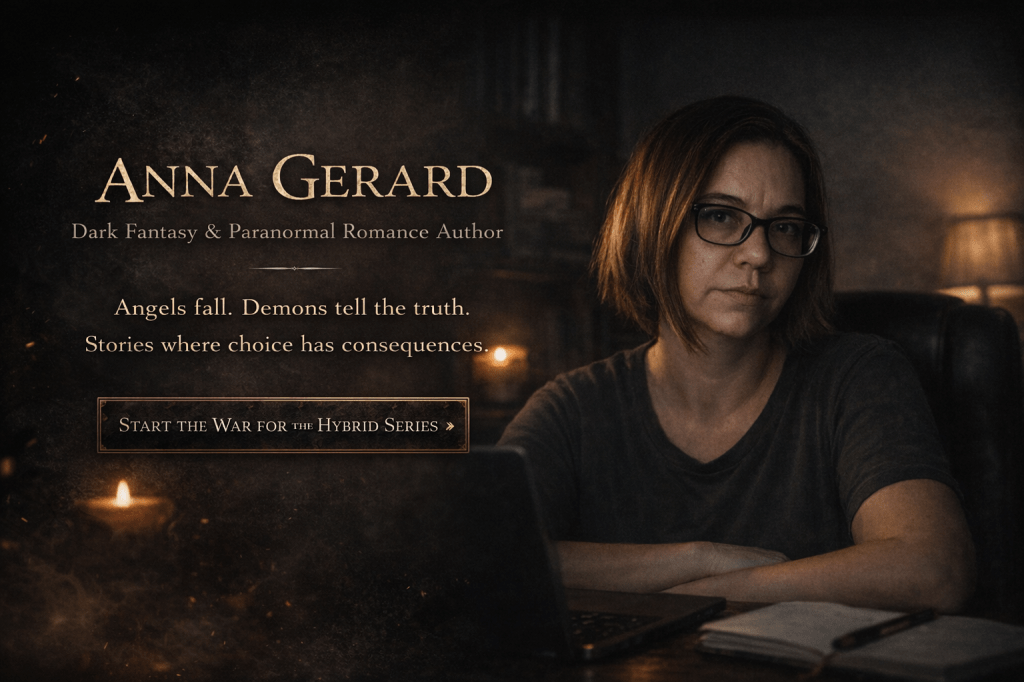


People occasionally ask where story ideas come from.
I wish I had an impressive author answer.
Something involving a beautiful writing desk, carefully organized notebooks, a steaming cup of coffee, and several uninterrupted hours in which inspiration arrives promptly for its scheduled appointment.
That sounds lovely.
It is also not how my brain works.
Story ideas tend to show up whenever they feel like it. When they disappear again, I rely on a few ways to find inspiration.
While I’m driving.
While I’m doing something completely unrelated to writing.
When I’m trying to fall asleep.
When I’m already working on another book and absolutely do not need a new character wandering into my head demanding attention.
Apparently fictional people have no respect for schedules.
Usually, It Starts With Something Tiny
I don’t always start with an entire plot.
Sometimes it’s a character.
Sometimes it’s a scene I can see so clearly that I know I have to figure out what happened before it and what happens afterward.
Sometimes it’s one ridiculous question:
What if?
What if this person wasn’t who everyone thought they were?
What if the person you’re supposed to hate is the only one telling the truth?
What if two people who absolutely should not fall in love do exactly that?
What if the choice that saves one person destroys someone else?
That’s usually when things begin getting interesting.
One little idea becomes another.
Then another.
Suddenly there are characters, relationships, secrets, rules, histories, betrayals, and enough fictional problems to keep everyone miserable for several hundred pages.
You know.
Romance.
My Characters Rarely Cooperate
This sounds ridiculous if you’ve never written fiction, but characters have an irritating habit of developing opinions.
I’ll know exactly how I think a scene should happen.
Then I’ll start writing it and realize the character would never actually do what I’ve planned.
Excuse me?
I created you.
Unfortunately, that doesn’t matter.
Once I understand who a character is, forcing them to do something simply because it’s convenient for the plot makes the story feel wrong.
So the scene changes.
Which changes something three chapters later.
Which means something earlier suddenly needs adjusting.
And this is how an innocent afternoon of writing turns into me rearranging half a book because one imaginary person refused to cooperate.
Very professional operation we’re running here.
The Messy Part Is Usually Where the Good Stuff Happens
Not every idea works.
Some scenes get deleted.
Some characters change dramatically between the first idea and the finished book.
Sometimes something I thought would be incredibly important becomes a tiny piece of the story.
Other times, a small detail I barely thought about becomes something much bigger.
That’s one of my favorite parts of writing.
Discovery.
Even when I know where a story is going, I don’t always know everything I’m going to find along the way.
A relationship develops differently than I expected.
A character reveals another layer.
A seemingly insignificant choice suddenly matters.
Those moments are addictive.
They’re also why writing can occasionally look less like calmly creating a novel and more like staring suspiciously at a laptop while muttering, Well, now what am I supposed to do with THAT?
Daydreaming Is Basically Part of the Job
I’ve always had stories running around in my head.
Writing simply gave them somewhere to go.
I can spend an absurd amount of time thinking about fictional conversations, scenes that haven’t happened yet, character motivations, worlds that don’t exist, and problems I deliberately created.
And somehow this qualifies as productive work.
Best loophole I’ve ever found.
But those daydreams are where the emotional pieces of a story often begin.
Before there are chapters, polished dialogue, covers, blurbs, or finished books, there’s usually just an idea.
A feeling.
A character.
A question.
Something that makes me want to know what happens next.
Then Somehow It Becomes a Book
This part still gets me.
Something that once existed only inside my head eventually becomes a real object someone else can hold.
Readers meet people who used to belong only to me.
They walk into worlds that started as daydreams.
They love characters I love.
They yell at characters I’ve yelled at.
They notice tiny details.
They form theories.
They occasionally become extremely opinionated about fictional people, which I fully support because I created them specifically to cause problems.
And suddenly the strange little idea that appeared while I was doing something completely ordinary isn’t mine anymore.
It’s a story.
That’s probably why I keep doing this.
Not because the process is neat.
It isn’t.
Not because inspiration arrives conveniently.
It absolutely does not.
But because somewhere between the chaos, caffeine, deleted scenes, stubborn characters, questionable decisions, and excessive daydreaming…
a world appears where there wasn’t one before.
And I still think that’s pretty incredible.